Somewhere in the history of almost every crypto wallet sits a permission the owner has completely forgotten about. Years ago, during one swap or one mint, the wallet told a token contract that some application may spend its balance — and that sentence, written into the blockchain, may still be standing. It costs nothing while it is harmless, and everything the moment the application behind it turns out to be malicious or gets exploited. Revoking token approvals is the housekeeping that closes this quiet attack surface, and unlike most security advice in crypto, it requires no special tools, no hardware and no expertise beyond knowing where to look and what to click.
What an approval actually does
Most tokens on ethereum and other EVM networks follow the ERC-20 standard, which separates two distinct rights: the right to own tokens and the right to move them. Ownership belongs to the address holding the balance. Movement rights are managed through an approval system, where the owner grants another address — usually a smart contract belonging to an application — permission to spend a certain amount.
This design exists for good reasons. A decentralized exchange cannot move your tokens unless you pre-authorize it, and pre-authorization lets you trade many times without paying a gas fee for a fresh approval each visit. The mechanism is efficient and, by itself, perfectly safe. The trouble starts with scope and longevity: an approval granted to a contract does not expire, does not notify you, and remains valid even if the application changes hands, gets exploited or simply disappears. The blockchain keeps the permission; only you can withdraw it.
The different shapes of permission
Approvals are not all equal, and knowing which kind you granted is the first step in deciding how much danger a wallet carries. The standard patterns behave very differently in practice.
| Approval type | What it grants | Risk if the spender turns hostile | Where it commonly appears |
|---|---|---|---|
| Unlimited token allowance | The contract may spend the entire balance, now and forever | Total loss of that token | Swap interfaces, lending apps, most DeFi sites |
| Exact-amount approval | The contract may spend a fixed number of tokens, once | Limited to the approved sum, and only until used | Sites that set precise spending caps |
| Permit signatures (EIP-2612) | A signed off-chain message authorizes a future spend | Can be relayed by anyone holding the signature; no separate transaction to revoke | Staking pages, newer token interfaces |
| Permit2 universal router | A single master approval feeding many protocols | One compromise can reach every permitted token | Aggregators and modern swap frontends |
| NFT operator approval (setApprovalForAll) | The contract may move every NFT of a collection, indefinitely | The whole collection can be drained | Marketplaces, mint pages |
Two entries in this table deserve a second look. The unlimited allowance is the most common and the most dangerous: it is offered as a convenience, “so you don’t have to approve again,” and most users accept it without realizing they have just handed over a standing lien on their entire balance. The setApprovalForAll pattern is its NFT equivalent, and it has been behind some of the most painful collection thefts on record. Exact-amount approvals, by contrast, self-destruct after use — which is why they are the safer default wherever an interface allows choosing.
Why revoking matters even for wallets you rarely use
The instinctive objection is “my wallet is fine, nothing bad has happened.” That logic misses how the attack actually arrives. A dormant approval is not static risk — it is live ammunition waiting for a trigger, and the trigger can come from three directions that have nothing to do with your own behavior.
The first is an exploit of the approved contract itself. If a protocol you trusted gets hacked, the attacker inherits every standing permission users granted it. Wallets that interacted once, years ago, become victims alongside current users. The second is a contract owner upgrade: many tokens and protocols have administrative functions that let the team change logic after deployment, and a permission granted to version one may suddenly serve version two, which you never reviewed. The third is your own future carelessness: a phishing link that gets signed once can enumerate your existing approvals and use them, without asking for any new signature. In each scenario, the damage is capped not by your vigilance today but by what you authorized in the past.
When to review and what to expect
Approvals accumulate the way subscriptions do — invisibly, one per application — so the review works best as a scheduled habit rather than an emergency response. A sensible rhythm: check after any intensive DeFi period, before and after participating in an airdrop or mint, whenever a protocol you used announces an exploit or an upgrade, and at least a couple of times a year as routine maintenance. The review itself follows the same shape everywhere on EVM networks.
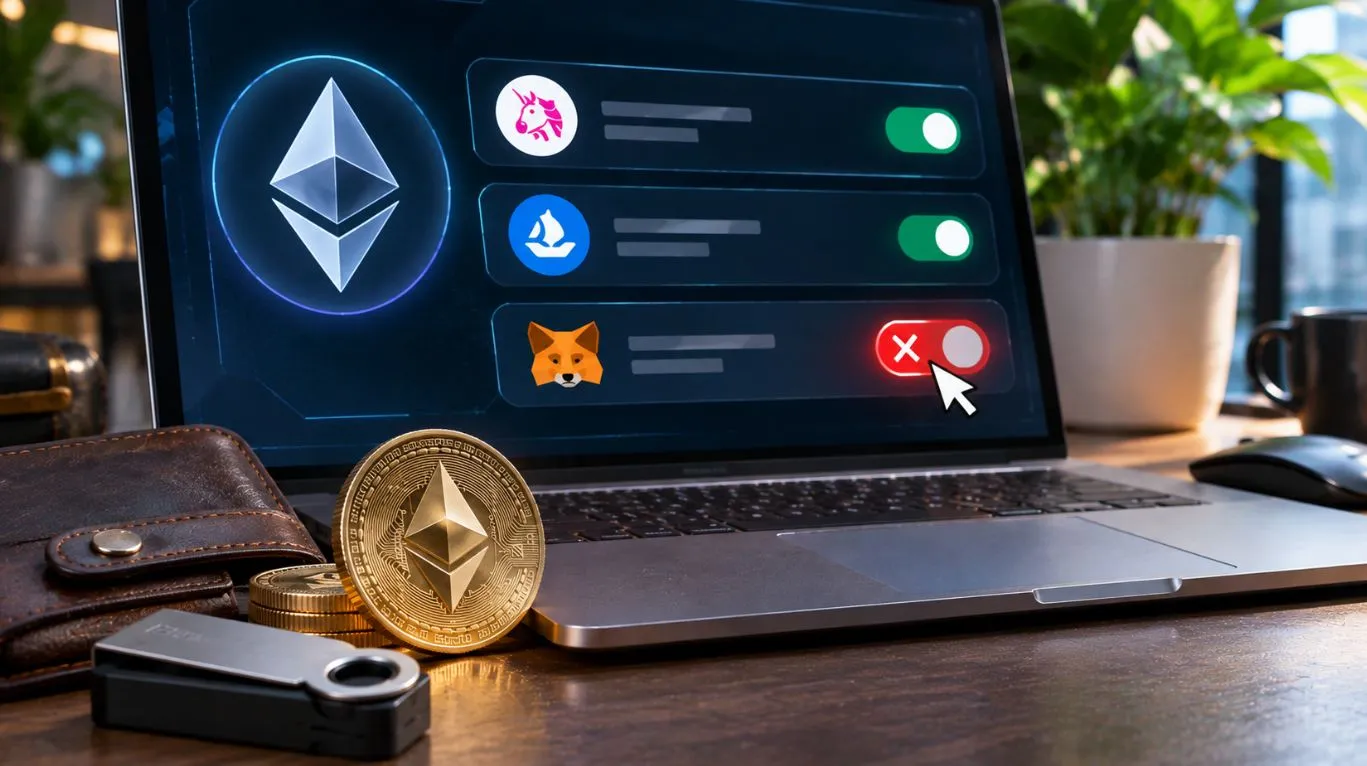
- Open a revocation tool or your wallet’s approval manager on the network where you suspect old permissions live. Tools such as token allowance checkers connect with your wallet in read-only mode, and several major wallets now surface active approvals in their settings.
- Review the full list of spenders. Expect names you remember, names you half-remember and contracts that show only as hexadecimal addresses. The unknown ones are exactly where the interest lies.
- Check every address against the protocol it claims to be. A legitimate spender address can be verified on a block explorer or by asking the application itself; an allowance pointing to an unrecognizable contract is a revocation candidate on sight.
- Revoke selectively. Kill unlimited allowances to anything you do not use actively, all allowances to forgotten projects, every setApprovalForAll for marketplaces you no longer sell on, and anything that survived a protocol’s own security incident.
- Confirm each revocation on-chain. Every revocation is a real transaction that costs gas, so batch the cleanup on networks with low fees rather than paying premium rates for housekeeping.
One clarification prevents a common disappointment: revoking protects the future, not the past. If a drainer already moved the tokens, no permission management recovers them. The value of revocation lies in disarming the threats that have not fired yet — and since most wallets carry approvals whose spenders no longer exist as businesses, the disarmament is real.
What revocation does and does not fix
The scope of this housekeeping is precise, and knowing its edges prevents both false confidence and wasted effort.
- Token allowances for ERC-20 assets are fully controllable: revoking sets the allowance back to zero, and the spender can no longer touch the balance.
- NFT operator approvals are likewise revocable per collection, and clearing them is the standard response after any suspicious marketplace interaction.
- Permit-style signatures are the awkward case. A signed permit is an off-chain message that becomes spendable once someone broadcasts it, and there is no on-chain allowance to reset until that happens. The practical defense is refusing meaningless permit requests rather than managing them afterward.
- Already-executed transactions are outside anyone’s reach. Revocation, like every security control, operates only on permissions that have not yet been used.
- Signatures other than permits, including the general-purpose authorization standards some contracts use, have their own revocation mechanics — the revocation tools increasingly surface these too, but their behavior varies and deserves individual care.
Keeping these boundaries in mind turns revocation from a vague ritual into a targeted procedure: unlimited ERC-20 allowances and NFT operator grants are the meat of the cleanup, permits are a prevention problem, and everything already stolen is a different conversation entirely.
Habits that reduce the cleanup forever
Revocation tools treat symptoms; spending habits prevent the disease. Four adjustments shrink the approval surface dramatically, and they cost little beyond attention at the moment of granting.
First, prefer exact-amount approvals wherever an interface offers the choice. The seconds saved by “approve unlimited” are not worth a standing lien on the balance. Second, dedicate wallets by purpose: a hot wallet that touches new applications should hold only what those experiments can cost, while savings live in a wallet whose approvals are by definition short and few. Third, after finishing with an application, revoke while you remember it — the cleanup is cheapest when the context is fresh, not months later when the spender’s name rings a vague bell. Fourth, treat a protocol’s security incident as a personal deadline: the moment a project you approved announces an exploit, your own permissions to it become attack surface regardless of whether the incident “seems unrelated.”
The wider picture
Token approvals are one of the quiet ironies of permissionless finance: the system that lets you interact with applications without intermediaries also lets old permissions outlive the applications themselves. The networks cannot fix this by design, because revocability is exactly what makes the permission system work — the power to grant and the power to withdraw belong to the same holder. That holder is you.
A wallet with a clean approval list is a smaller target than a wallet with a long memory of every protocol it ever visited. The check takes minutes, the revocations cost pennies on cheap networks, and the payoff is a wallet whose risk reflects what you use today rather than everything you ever tried. In a corner of the internet where past decisions can reach into the present, that difference is not housekeeping — it is the whole game.