Every crypto journey eventually reaches the same moment. The coins have done their job, the price is where you wanted it to be, and now the balance needs to become rent money, a car payment or simply money you can actually spend. Cashing out is the least glamorous part of crypto and, for many people, the most confusing: it involves exchanges, bank rules, identity checks, fees that vary by method and tax obligations that vary by country. The process is genuinely simple once the moving parts are clear, but each part has a way of tripping up first-timers, and some mistakes — like sending to the wrong network or skipping record-keeping — are expensive to undo. Here is how the machinery works and how to use it without overpaying.
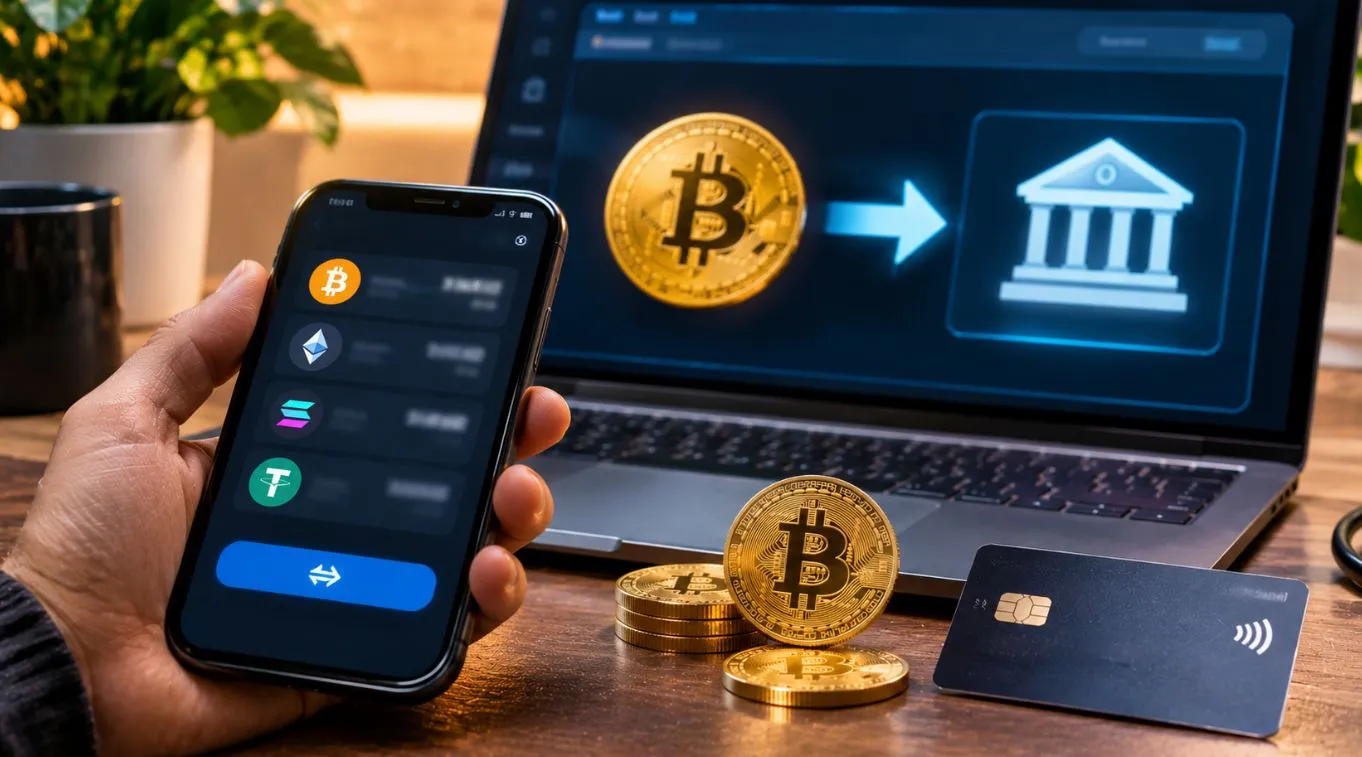
The journey of a coin from your wallet to your bank
Before choosing a method, it helps to see what is actually happening. Cashing out is not one action but a short chain of conversions, each with its own cost and timing.
- Get the funds to a sellable venue. If your crypto sits in a self-custody wallet, it first travels to an exchange, a broker or a peer, unless you use an on-ramp service that pays you directly.
- Convert to fiat. The crypto is sold for your local currency — dollars, euros, pounds — either at the market price or through an instant quote that bundles its own margin.
- Withdraw to your bank. The fiat balance leaves the platform through a bank transfer, a card payout or a payment service, landing in an account you control.
- Account for taxes. The sale itself is usually a taxable event, and the records you keep at this stage determine how much of the profit ends up with the tax office versus in your pocket.
Each link in this chain can be chosen independently. Some people sell on one platform and withdraw through another; some skip the exchange entirely and trade with a person face to face. The right combination depends on the amount, the urgency and how much you are willing to pay for convenience.
The main ways to cash out
No single method wins on every axis. Each route optimizes for something — speed, price, privacy or simplicity — and the differences are large enough that picking carelessly can cost several percent of the total. The main options are these:
- Centralized exchanges are the workhorse: sell crypto for fiat at the market price, then withdraw via bank transfer. Best all-around pricing for larger amounts, with fees typically between 0.1% and 1% on the sale plus a small flat withdrawal fee.
- Instant sell features and crypto-linked cards convert at the push of a button, usually with a markup of 1–3% hidden in the quote. The trade-off is speed and simplicity versus price.
- Peer-to-peer (P2P) platforms connect sellers directly with buyers paying through bank transfers or payment apps. Rates can beat exchange prices, but escrow discipline and scam awareness become part of the job.
- Crypto ATMs pay cash on the spot, which appeals to people who want physical money without bank involvement. The price is steep: margins and fees frequently total 5–10% or more.
- Debit cards linked to crypto wallets turn every purchase into an automatic sale, effectively cashing out piecemeal in daily life.
- Over-the-counter (OTC) desks handle large sums — typically six figures and up — with negotiated rates, personal service and direct bank settlement.
For most people, the realistic shortlist is the exchange route for anything substantial and an instant-sell or card route for small, frequent amounts. P2P fills the gap where exchange access or banking rails are limited, but it demands the most caution per dollar.
How the methods compare on the numbers that matter
Fees, speed and practical ceilings differ enough across methods that a side-by-side view saves real money. The figures below are typical ranges and vary by country, platform and bank.
| Method | Typical total cost | Time to bank | Best suited for |
|---|---|---|---|
| Centralized exchange sale + bank withdrawal | 0.5–2% all-in | Hours to 1–3 business days | Amounts of any size, best pricing |
| Instant sell in wallet or exchange app | 1–4% | Minutes to hours | Small amounts, urgent needs |
| P2P sale | 0–2%, sometimes negative vs market | 15 minutes to a day | Beating market price where banking is tricky |
| Crypto ATM | 5–12% | Immediate (cash) | Small, urgent, in-person cash needs |
| Crypto-linked debit card | 1–3% per spend | Immediate (as spending) | Ongoing everyday spending from crypto |
| OTC desk | ~0.2–1% | Same day to days | Large six-figure-plus volumes |
The pattern is consistent: convenience is priced in percentages. An instant sell costs roughly ten times what a patient exchange sale costs, and an ATM can cost twenty times more. For someone cashing out a meaningful amount, spending an extra day waiting for a bank transfer is usually the cheapest decision available. For a hundred-dollar emergency at midnight, the ATM markup is the price of not caring about math.
Limits, verification and why banks sometimes ask questions
Every legitimate route to a bank account runs through identity verification. Exchanges enforce tiered limits: unverified accounts can withdraw little or nothing, basic verification unlocks moderate amounts, and full verification with proof of address raises the ceiling dramatically. Large withdrawals — especially repeated ones — trigger additional review, and this is normal rather than hostile: banks and exchanges are required to monitor unusual flows.
The bank side has its own logic. Incoming transfers from crypto-related platforms are perfectly legal in most jurisdictions, but some banks hold or query them out of caution. Practical habits that keep the experience smooth include these:
- Use an account whose name exactly matches the identity you verified on the exchange; third-party names cause frozen transfers.
- For large sums, withdraw in tranches rather than one giant transfer, and keep records linking each withdrawal to the sale that funded it.
- Be ready to show the paper trail — the exchange statement or the P2P receipt — if the bank asks what the transfer is for. A one-sentence honest answer resolves most holds.
- Never let someone else use your account to receive their crypto proceeds; “helping a friend” is the fastest way to a frozen account and a compliance nightmare.
None of these steps makes cashing out harder than it needs to be; they make it harder for the process to stall at the worst moment. The people who run into serious trouble are almost always those who skipped verification ahead of time or mixed funds with unexplained sources.
Fees and spreads: where the money actually goes
Two figures determine the real cost of any cash-out: the visible fee and the hidden spread. The visible fee is the commission on the sale or the flat withdrawal charge — easy to see, easy to compare. The spread is the gap between the market price and the price you actually get, and it is where instant services earn their markup. An exchange order at the market price typically costs a fraction of a percent plus a flat withdrawal of a few dollars; an instant quote quietly includes 1–3%; a ATM quote includes 5% or more on top of its printed fee.
Network fees also belong in the arithmetic, though they bite only when moving crypto from a personal wallet to an exchange before selling. On some blockchains, especially during congestion, that transfer can cost a noticeable slice of a small balance — which is one more reason small amounts are often better left spent than sold. Stablecoins deserve a mention of their own: selling a stablecoin pegged to your currency through the direct fiat pair usually costs less than selling a volatile coin, which is why many people convert volatile assets to stablecoins during favorable prices and time the fiat sale separately.
Getting the records right before the sale
Taxes are the step people skip and later regret. In most jurisdictions, selling crypto is a taxable disposal: the gain or loss is measured against what you originally paid, not against the full sale amount. That makes cost-basis records — dates, amounts and purchase prices of every acquisition — the decisive paperwork. Practical preparation looks like this:
- Export transaction history from every exchange and wallet you have used, before you start selling.
- Determine the accounting method your country uses — first-in-first-out, last-in, or specific identification — because choosing the right one can materially change the taxable gain.
- Keep sale confirmations, withdrawal receipts and bank statements together; the chain from wallet to bank is what tax authorities want to see.
- Consider consulting a tax professional for large or complicated positions, especially if the crypto was acquired years ago across multiple platforms or via trades.
A few hours of organization before the sale prevents the far worse scenario of reconstructing history from memory months later. Tax software can automate most of this, but only if the underlying records exist.
A sensible order for the whole operation
Bringing the pieces together, a well-run cash-out for a typical amount looks like a sequence rather than a scramble. Verify your account fully and confirm your bank details before you need the money, not during an emergency. Move the crypto to the venue with the best pricing, sell at the market through a limit or market order rather than an instant quote, withdraw to your own bank account in amounts your bank finds unremarkable, and archive the documentation the moment the transfer lands. If speed is not urgent, spreading the sale over several days also smooths out price risk, since nobody reliably predicts short-term movements.
The unglamorous truth about cashing out is that the crypto part is the easy half. The fiat half — banking rules, limits, records and taxes — is where outcomes are decided, and it rewards exactly one strategy: doing the boring verification and paperwork before the moment of need arrives. Users who treat the withdrawal path as routine maintenance rather than an emergency measure find that turning bitcoin into bank balance is, in the end, a quiet, uneventful errand — which is precisely what it should be.