Buying bitcoin used to mean one thing: opening an account, wiring money and holding the coins yourself. Then exchange-traded funds arrived and quietly turned a crypto decision into a brokerage decision. Millions of dollars now flow into bitcoin ETFs from people who will never touch a crypto exchange, a seed phrase or a hardware wallet. That raises a question every bitcoin investor eventually faces: is it better to own the coin itself or to own a fund that holds it for you? The answer depends less on the technology than on what you are actually trying to achieve — price exposure, true ownership, or something in between — and on how much complexity you are willing to manage for what you get in return.
What a bitcoin ETF really is
An ETF is a fund listed on a stock exchange. When you buy a share of a spot bitcoin ETF, you are buying a slice of a fund that holds actual bitcoin in institutional custody. The share trades in your brokerage account, in your local currency, inside accounts that are already protected by familiar securities rules. You never see a wallet address, never generate a key and never interact with a blockchain. The fund does all of that on your behalf.
The simplicity is real, but so are the boundaries. An ETF share is a claim on the fund, not a claim on specific coins. You cannot withdraw bitcoin to your own wallet, spend it, lend it or use it in any application, because what you own is a security, not the asset itself. For investors who only care about the price moving up, this distinction may be irrelevant. For anyone who values bitcoin for its self-custodial properties — the ability to hold an asset no institution can freeze — the distinction is the entire point.
What direct ownership actually means
Owning bitcoin directly means controlling the private keys that authorize its movement. The coins live at addresses on the blockchain, and whoever holds the keys holds the coins, with no intermediary between you and the asset. This is the property summarized in the well-known saying “not your keys, not your coins.”
Direct ownership also comes in gradations. Keeping bitcoin on an exchange account is technically direct exposure to the asset, but the exchange holds the keys, which makes it closer in spirit to an ETF than to self-custody. Full ownership means the keys live with you — in a hot wallet for small amounts, in a hardware wallet for savings — with backups you personally maintain and nobody can revoke.
Which route fits which goal
Because the two options serve different purposes, the choice usually resolves itself once the goal is stated clearly. The following scenarios cover the situations most investors find themselves in.
- You want bitcoin exposure inside a retirement or brokerage account. An ETF is often the only practical route, since many tax-advantaged accounts cannot hold crypto directly.
- You believe in self-custody as the core idea of bitcoin. Direct ownership with your own keys is the only way to exercise it, because a fund share is always mediated by an institution.
- You want simplicity above all else. An ETF lives inside an app you already use, needs no seed phrases, no backups and no security learning curve.
- You plan to use bitcoin, not just hold it. Spending, sending across borders or interacting with applications requires the actual asset in your own wallet.
- You worry about the fund’s counterparty risks. Direct self-custody eliminates reliance on fund managers, custodians and their operational chains.
- You are managing a large position for the long term. Many experienced holders split between both: a self-custodied core and an ETF layer for convenience or account-level reasons.
Working through these scenarios usually shows that the question is not “which is better” but “better for what.” An investor who only wants price exposure to the asset’s long-term trajectory is comparing two products that deliver nearly the same thing; an investor who wants the properties of bitcoin itself is not.
How the costs stack up
Fees are where the two routes diverge in ways that are easy to underestimate. ETF expense ratios, typically ranging from roughly 0.19% to 1.5% per year depending on the fund, are deducted continuously from the fund’s holdings — invisible, but real, and compounding over years. Direct ownership has no ongoing management fee, but it is not free: exchange trading fees on purchases, spread costs, network fees on transfers, and the one-time price of a hardware wallet for serious amounts. Over long holding periods, the math generally favors direct ownership, since a fraction of a percent per year adds up while a hardware wallet is paid for once.
The picture changes when trading frequency rises. For someone who buys and sells regularly, brokerage commissions on ETF trades are often comparable to or lower than crypto exchange fees, and the ability to place limit orders, trade during market hours and hold the position inside familiar account types adds practical value that is hard to price but easy to feel.
Side-by-side comparison
The core differences between the two routes come down to a handful of dimensions that determine the day-to-day experience of holding each one.
| Aspect | Bitcoin ETF | Direct bitcoin ownership |
|---|---|---|
| What you actually hold | A fund share backed by pooled bitcoin | The asset itself, controlled by your private keys |
| Control and access | Managed by the fund; no withdrawals, transfers or on-chain use possible | Full control; send, receive, spend and store without permission |
| Ongoing fees | Annual expense ratio deducted automatically | No ongoing fee; costs come at purchase, transfer and hardware one time |
| Security burden | Borne by the fund and its custodians | Borne entirely by you, including backups and key handling |
| Account protection | Securities rules, broker protections, regulated reporting | Self-custody protections that depend on your own practices |
| Access hours | Market hours only, in fiat currency | Around the clock, including peer-to-peer and on-chain transfers |
| Usability in payments and applications | None; the share cannot leave the brokerage system | Complete, wherever the asset is accepted |
| Tax and paperwork | Handled through standard brokerage statements | Depends on jurisdiction; self-reported, sometimes more complex |
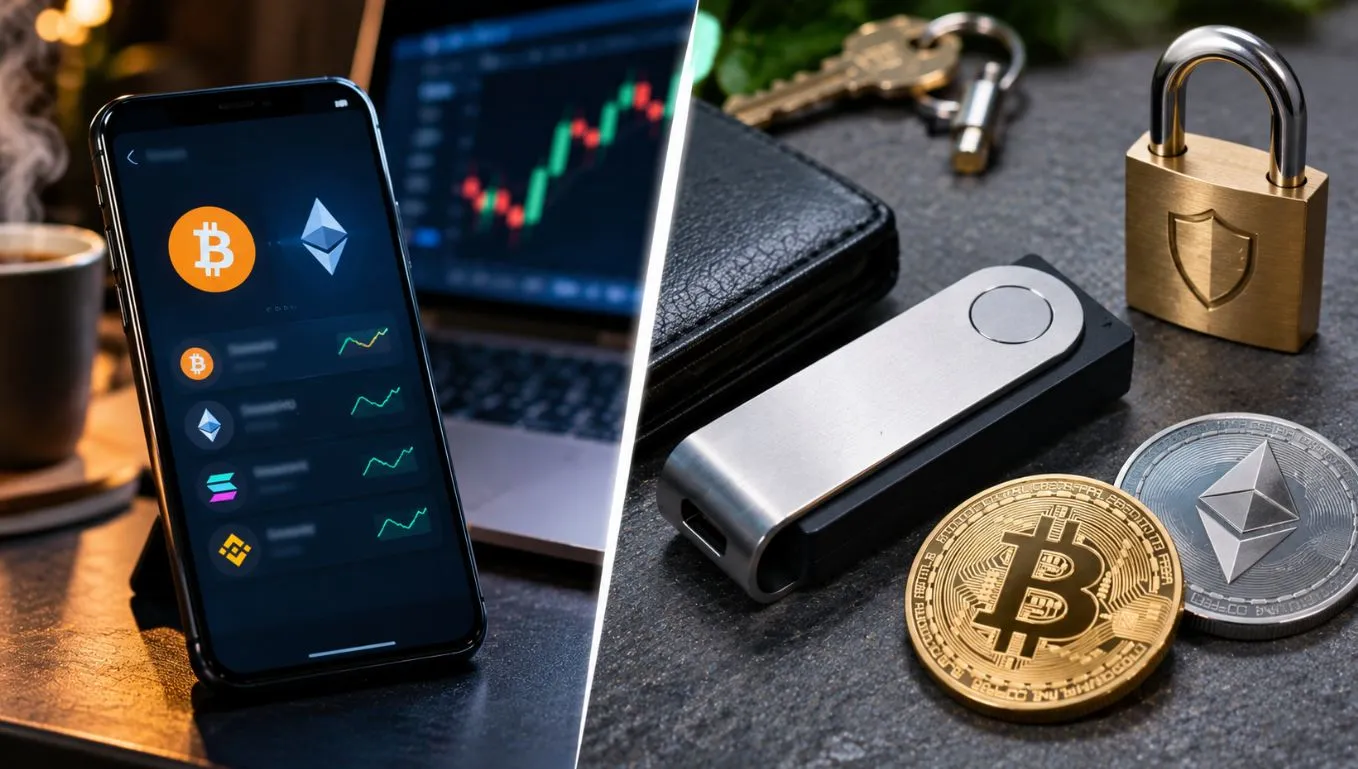
Reading the two columns together reveals the fundamental trade: an ETF outsources responsibility and charges a recurring fee for it, while direct ownership keeps full control and charges nothing recurring — but demands that you handle the responsibilities yourself. Neither column is objectively superior; the costs and benefits simply land on different people differently.
The risk profiles are not the same
It is tempting to think both routes share identical price risk and differ only in convenience. In reality, each carries risks the other does not have at all.
An ETF holder carries fund-level and market-level risks: the possibility of tracking errors between the share price and bitcoin’s actual price, premium or discount distortions, the operational health of the fund and its custodian, trading halts on extreme days, and the broader risk of regulatory changes to the fund structure. The investor is also exposed to the failure modes of the brokerage account itself. What the ETF holder never carries is key-management risk — there is no seed phrase to lose and no wallet to compromise.
A direct holder carries the full stack of self-custody risks: phishing and drainer scams aimed at wallets, malware on the device holding keys, lost or destroyed backups, simple human error during transactions, and the permanent nature of mistakes. There is no custodian to appeal to and no statement to reconcile. In exchange, the direct holder is immune to fund-level failures and can act at any moment, including during market closures when exchange-listed instruments cannot move.
These risk sets are largely non-overlapping, which is why the honest comparison is not “which is riskier” but “which risks are you better equipped to manage.” A disciplined self-custodian faces less total risk than a careless one pretending an ETF removes all danger, and vice versa.
Taxes, accounts and accessibility
The practical details around taxes and account access often decide the matter more than philosophy does. ETF gains flow through standard brokerage reporting, with dividends from futures-based funds, capital gains on sales and straightforward documentation that most tax software handles natively. Direct bitcoin ownership in many jurisdictions requires tracking cost basis across purchases, reporting each disposition and, in some countries, treating every spend as a taxable event — a burden that grows with transaction frequency.
Accessibility differs just as sharply. ETFs are available to anyone with a brokerage account, including inside retirement accounts in many countries, and they sidestep the onboarding friction, identity checks and regional restrictions that crypto exchanges impose. Direct ownership, by contrast, requires reaching a functioning exchange, understanding wallet software and, in some regions, navigating banking friction when funding the purchase. The gradient runs in one direction: ETFs are easier to enter, direct ownership is easier to use once you are in.
A pragmatic way to combine both
For many holders, the strongest answer is not picking a side at all. A layered approach — self-custodied bitcoin as the foundation, an ETF position where account structures or convenience justify it — captures the strengths of both while keeping the weaknesses of each contained. The split is personal: some hold the large majority in self-custody with an ETF sliver for retirement-account flexibility, others do the reverse because they trust regulated custodians more than their own ability to keep a phrase safe for decades.
What matters most is that the decision be made deliberately. The failure mode common to both routes is drift: buying an ETF because it appeared in a brokerage app without understanding what a fund share is, or buying bitcoin on an exchange and calling it self-custody without realizing the keys still belong to someone else. Investors who understand exactly what they hold — a claim, or the thing itself — tend to keep it longer and panic less when prices swing. In a market defined by volatility, that clarity may end up being worth more than any difference in fees.