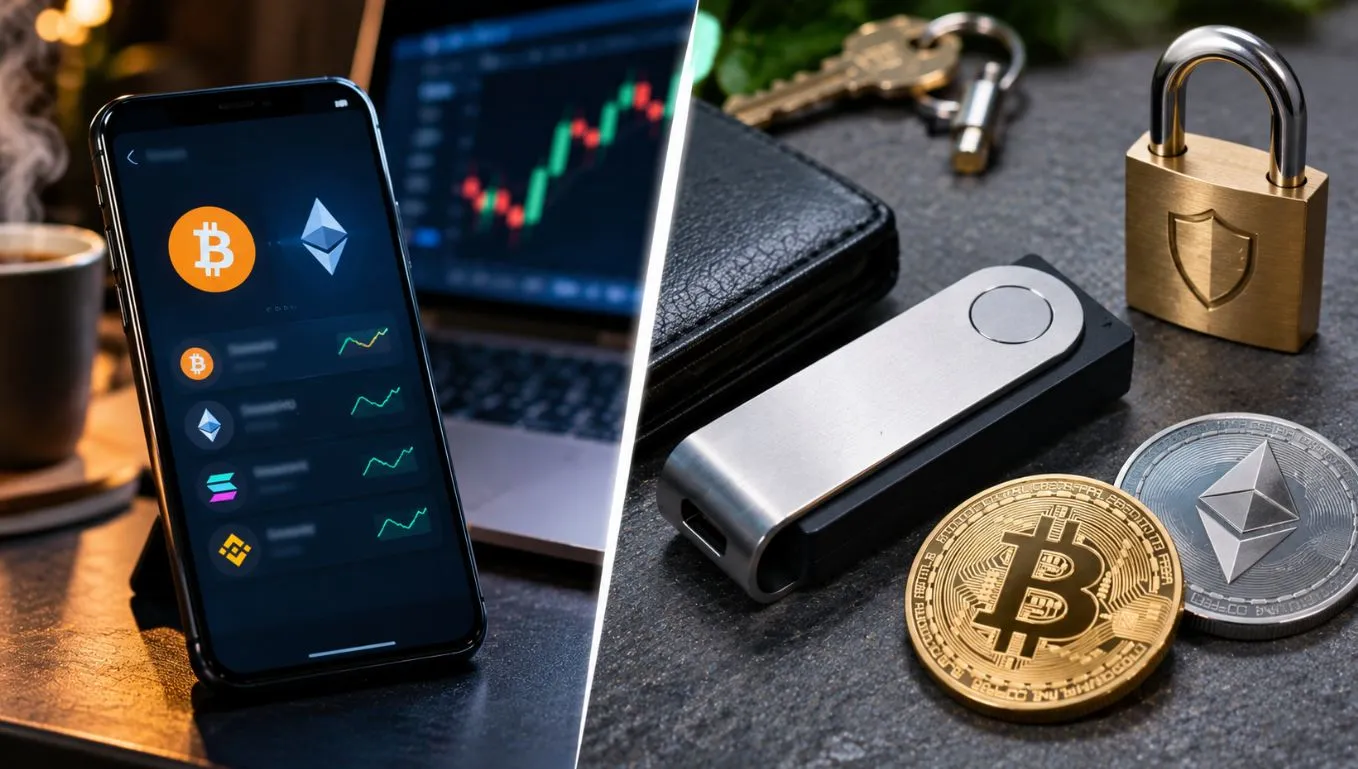
Ask ten people which wallet keeps crypto safest and you will get ten confident answers, half of them wrong. The honest version is less satisfying but more useful: neither a hot wallet nor a cold wallet is “safer” in the abstract. Each one protects against a different kind of threat, and each one fails in a different way. A hot wallet is like cash in your pocket — easy to spend, easy to lose. A cold wallet is like a safe deposit box — hard for anyone to reach, including you, until you deliberately unlock it. The real question is not which one to own, but which one to trust with which amount of money, and whether you are willing to maintain both.
What the two terms actually mean
The difference between hot and cold has nothing to do with brand, price or the shape of the device. It is a question of network connection. A hot wallet keeps its private keys on a device that touches the internet — a phone app, a browser extension, an exchange account. A cold wallet keeps its keys on hardware or paper that never talks to the network, signing transactions only when physically connected to an internet-facing machine, and even then, only inside its own secure chip.
This single distinction explains everything else. Because a hot wallet’s keys live on a connected device, anyone who compromises that device — through malware, phishing, a stolen phone, a compromised cloud backup — can take the funds silently. Because a cold wallet’s keys live in isolation, an attacker has to get physical access to the device or trick the owner into signing something malicious. Different walls, different doors, and the right choice depends on which door you are more likely to leave open.
How a hot wallet works in practice
A hot wallet generates and stores keys locally, encrypted behind a password or PIN. When you send funds, it constructs the transaction and signs it with the key directly on your device. This all happens in seconds, which is exactly why people love it: paying, swapping, interacting with applications and receiving payments are frictionless.
The same convenience defines its risk profile. The key material sits on hardware that constantly faces a hostile network. Attacks against hot wallets are rarely exotic — they are malware that copies clipboard contents, fake wallet apps, malicious browser extensions, cloud-synced backups that leak, and phishing sites that request a signature. Hot wallet users do not get robbed by breaking cryptography; they get robbed by social engineering and ordinary device infections.
How a cold wallet works in practice
A cold wallet, in its most common form, is a small dedicated device that holds keys in a secure element and never exposes them to the connected computer. When a transaction needs signing, the unsigned transaction goes to the device, the device signs it internally, and only the signed result comes back. The private key never leaves the chip. Even a fully compromised computer cannot extract it, because it simply is not there to extract.
Paper wallets — keys printed or written down with no digital copy — are technically cold too, but they are a poor implementation: spending from them requires importing the key into a hot environment, which momentarily makes it warm. Modern cold storage almost always means a hardware wallet paired with an interface application, with the seed phrase written on durable material and stored offline.
Risks each option carries
Both approaches fail, just not in the same places. Comparing the failure modes side by side makes the trade-offs concrete.
| Risk | Hot wallet | Cold wallet |
|---|---|---|
| Remote hacking or malware | Key material is exposed to a compromised device | Keys never touch the internet; device can be attacked only while connected, and still cannot leak the key |
| Phishing and malicious signatures | Signing requests can fool the user easily; approvals drain funds instantly | The device screen shows the real transaction, so spoofed interfaces are visible, though user attention is still required |
| Physical theft or loss | Stolen phone with the app is usually useless without the PIN, but device malware may already have the keys | Stolen device is protected by a PIN and cannot reveal keys; losing the device matters only for convenience, not safety |
| Damage or destruction | Device loss is recoverable from the seed phrase | Device loss is recoverable from the seed phrase, which is why backup discipline matters more than the device itself |
| User error | Accidental approvals, wrong addresses, malware-altered transactions | Choosing fake devices from unofficial sellers, entering the phrase into a website, mishandling the backup |
| Cost | Usually free | Requires buying hardware and treating its seed phrase with real care |
The pattern in this comparison is consistent: a hot wallet’s risks concentrate in the software and the network around it, while a cold wallet’s risks concentrate in the physical object and, above all, in the human handling it. Neither option transfers responsibility away from the user — it just moves where the responsibility sits.
Where each one genuinely fits
The strongest storage strategy is not picking a winner but assigning each tool to the job it is built for. That mapping looks different for a casual holder, a frequent trader and a long-term saver, so the practical rule is about amounts and activity, not ideology.
- Small, everyday amounts belong in a hot wallet: spending, swapping, paying, experimenting with new applications, where the balance is affordable to lose entirely.
- Long-term savings belong in cold storage, ideally untouched for months, with the seed phrase stored in multiple separated physical copies.
- Active trading balances can sit on an exchange or in a hot wallet, sized so that a platform failure or a compromise would sting but not devastate.
- Interactions with new or unverified platforms should always happen from a dedicated hot wallet holding only what that experiment can cost.
- Receiving regular payments works well in a hot wallet, with periodic transfers of the accumulated amount into cold storage.
- Inheritance planning requires cold storage with a documented, tested backup that a trusted person can eventually access.
Seen this way, the hot-versus-cold debate dissolves. Most people who hold anything meaningful eventually arrive at the same arrangement: a hot wallet as the front pocket and a cold wallet as the vault, with money flowing in one direction over time.
Choosing between them for your situation
If you are starting out with a small amount, a reputable hot wallet is a perfectly reasonable first home — the practical risk of losing access to a clumsy cold-storage setup may actually exceed the security benefit. As the balance grows toward amounts that would genuinely hurt to lose, the calculus shifts, and a hardware wallet stops being overkill. A useful threshold many experienced holders use is this: the moment losing the entire hot wallet balance would be a real financial problem rather than a lesson, that balance should move to cold storage.
When choosing a specific cold device, three checks matter more than any feature list. Buy directly from the manufacturer or an authorized reseller, never from a marketplace where packages can be pre-tampered or resold with pre-generated phrases. Verify the device’s authenticity through its built-in check on first use. And treat the recovery phrase as the true wallet — the device is replaceable, the phrase is not.
The layer that decides everything: your behavior
Both wallet types depend on habits that no device can enforce. On the hot side, the essential discipline is avoiding unknown sites, reading every transaction request before signing, keeping device software updated and never reusing a hot wallet password across services. On the cold side, the discipline is quieter but heavier: the seed phrase lives on paper or metal, never in a photo, a cloud note or a password manager; the phrase is never typed into any website under any pretext; and the backup is tested once by restoring it into a spare wallet.
There is also a behavioral middle ground worth knowing. Multisignature arrangements, where two or three separate keys must cooperate to move funds, and passphrase-protected setups add resilience, but they also add complexity, and complexity is its own source of loss. Every extra layer should earn its place by solving a problem you actually have, not by making the setup feel more impressive.
So which is safer?
If the question is forced into a single answer, cold storage is safer against theft and hot storage is safer against user error — and that second part is easy to underestimate. A hardware wallet in the hands of someone who writes the recovery phrase into a note app is less safe than a well-managed hot wallet. The safest setup for almost everyone is not a wallet but a system: cold storage for the bulk of funds that rarely move, a hot wallet for the small amounts that do, backups that are tested and physically separated, and the standing habit of treating every signature request as a decision rather than a formality. Security in crypto is not a purchase; it is a routine, and the routine is what finally answers the question the title asks.